Wednesday, 1 April 2009

The original's always the best.

First of all, I've put another book up on Tatty Jackets.

Secondly, I'm a bit bemused by the controversy - if there is indeed a fire lurking behind the Daily Mail's industrial smoke machine - surrounding the BBC's Robin Hood series. I seem to remember some previous grumblings about them making it all dumbed down and relevant (as if making a program no-one's interested in would be a better use of the license fee) but it's the introduction of a martial arts expert that's caused the latest kerfuffle. Hang about, that should read "black martial arts expert".

Now, I can sometimes be a stickler for historical accuracy, but it only has steam coming out of my ears when it's a rubbish, misleading reenactment in what's supposed to be a serious documentary. This is fiction. It's a fictional series loosely based around a character who has appeared in lots of other fiction. Absolutely none of his appearances can be considered more 'accurate' than the others.

Maybe some people would disagree and claim that you can trace a likely candidate for the 'real' Robin Hood, find his mortal remains, discover his height and build, run DNA tests, reconstruct his face, pin down exactly what years he was alive and dress him only in the fashion of the time, in the materials that would have been available. Above all, make sure he speaks only medieval English, in his local dialect. Oh, and perfect teeth are not an option.

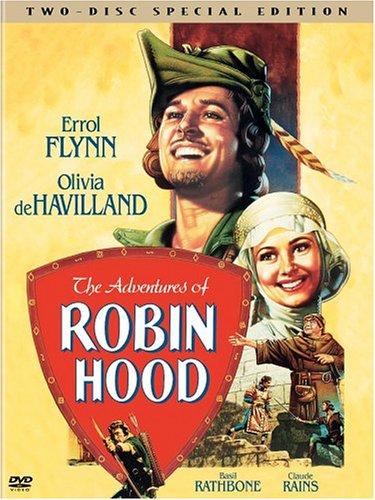
Does this sound like any Robin Hood you've ever seen? A quick image search reveals variety of hair colours and facial hair arrangements, shoes ranging from hobnailed and durable, to ridiculously pointy:


There's been a futuristic Robin Hood, a vain, idiotic Robin Hood whose band was led by Maid Marion (also on the BBC) and I don't think that was considered a problem. Nor do I recall howls of protest when Disney "reinvented" Friar Tuck as a bear.

This process of making stories more relevant to the audience is not a feature of modern political correctness or dumbing down. It's been carried out in various art forms for centuries. Artists have always sought to present characters in a new light, to make their audience think and see new aspects of the stories or morals they portray. That's the whole damn point of art - that's what separates fiction from fact. Do an image search for Helen of Troy or the Virgin Mary (ignoring any result involving toast) and you'll see how their clothes and hairstyles and stance were altered as tastes changed. Those medieval manuscripts that every European country is so proud of - most of those are rehashed old tales, chopping and splicing stories from different centuries and different areas, changing names, adding or removing characters. Digressing from these 'original' stories isn't some kind of travesty or a betrayal of our heritage. It's merely continuing an artistic process that those manuscripts were one small part of.

I only read through a few of the readers' comments before deciding that life is too short for that kind of thing but I still found one worth getting very, very angry about.


Well what a surprise, the BBC does it again. They won't be happy until they have completely removed all traces of native English culture from our land by brainwashing the public, gradually introducing anti English and dare I say it anti White propaganda; and by the way, its not racist to highlight the concerns of white people who want to hold on to their own culture!

Why is it suddenly racist to say I'm proud to be White? It's not racist to openly say I'm proud to be Black!

Why is it racist to say I love my country and my culture? It's not racist for a Black person to say I'm proud my homeland and my culture!

Having other races and faiths in the UK is fine, but don't tell me I'm racist for being proud of who I am!

These issues are a concern when we have the BBC trying to rewrite history in an attempt to put other cultures first!
Click to rate Rating 234

- John, Birmingham, England, 28/3/2009 14:52

Now, David Harewood was born in Birmingham. He has British citizenship, and no other. The legends of Robin Hood are as much a part of his cultural heritage as of any other Brit. We could of course decide that only actors who can prove that all of their ancestors since the reign of King John were born on English soil are worthy enough to play these characters. On the other hand, that would result in Robin Hood disappearing from our screens altogether. Then we'd have a real example of 'native English culture' being lost.


As always, my heartfelt thanks go to MacGuffin and all other bloggers who trawl their way through the tabloids so the rest of us don't have to.

Thursday, 22 January 2009

Once you start looking you can find it everywhere

This was going be a short post about one stupid thing but has ended up covering four very different kinds of stupid. I've attempted to rein in my criticism as far as possible, firstly because it's more fun if people find the stupid for themselves, and secondly because if I analyse these masterpieces of mindfartery for much longer the bile is going to reach and kill my brain.


  1. PETA's "Sea-kittens" campaign - As I wrote a post on this last year, I was delighted to see this topic hit the Guardian and - far more importantly - Unspeak. Ingrid Newkirk's defence of the campaign is less than convincing:
    And while "sea kitten hunting," formerly known as angling, is cruel to animals, commercial sea kitten hunting is environmentally catastrophic. It has devastated the ocean's ecosystem to the extent that large fish populations are only 10% what they were in the 1950s. Scientists warn that the damage caused by the fishing industry is irreparable.
    [...]
    We invite everyone of any age to play the sea kitten game and find out more about Peta's Sea Kittens campaign. It's a bit of fun with a serious message: never dismiss any individual's interests just because they look a bit funny.
    I completely agree that overfishing is a huge environmental problem which needs to be prevented as it cannot be cured later. What I don't get is why "everyone of any age" should be invited to wade through a flood of drivel before they can find out important facts about the situation. And how is that "serious message" in any way linked to the campaign? My mental faculties clearly aren't up to scratch, maybe I should start eating fish.

  2. Elizabeth Wurtzel's explanation of how all criticism of Israel is anti-semitic - One reason I love the Guardian's Comment is Free section is that people are given space to explain opinions that you may have suspected were only straw-man positions. I've come across many things refuting this idea but never met anyone who supported it. Wurtzel's article is similar to Newkirk's defence of PETA, in that it only serves to inspire fresh counter-arguments. I have one thing that I'd like to add to the existing criticism of this article, specifically countering this assertion:
    [...]while I'd like to artificially separate anti-Zionism from antisemitism, like most American Jews, I'm not willing to make that false distinction: when there is more than one Jewish state, the world's hatred of Israel might become no different from its exasperation with any other country, but since Israel is the only homeland, and really it is nothing more than six million Jews living together in an area the size of New Jersey, I can't pretend that the problem with Israel is that it's a poorly located country that happens to be at odds with its neighbours and only coincidentally happens to be Jewish. The trouble with Israel is the trouble with Jews.

    In fact it's easier to make a distinction between "the Jews" and Israel than it is to separate a country from its citizens. Whether you're talking about Judaism or "Jewishness", you're discussing a worldwide community of millions of people, with vastly different backgrounds and opinions, with members who have inspired profound respect in many different fields. Israel is just one political / geographical entity. It's really very difficult to confuse the two, unlike discussions about "Iran" and "the Iranians", for example.

  3. "Six months after the MMR jab... a bubbly little girl now struggles to speak, walk and feed herself" - If there's one word I'd like to ban from Daily Mail headlines, it's "after". This article made me very angry indeed, being the shameless exploitation of a parent's fear and misery in order to shamelessly exploit other parents just to sell cheap paper to wrap potato peelings in. Every damn line is either persuading parents to mistrust vaccinations or manipulating their emotions to make the persuasion all the more effective. It's such a dangerous campaign to run, with absolutely no reason for it, but once tabloids get up on a high horse they'll happily trample anyone into the mud. It seems impossible to me that a literate individual could write the following sentences and not grasp the reality of the situation:

    [Doctors] have told Melody's mother Alicia Ellis, 25, there is no reason to believe the MMR vaccine has anything to do with her condition.
    However, Miss Ellis is convinced it is the only logical explanation and there could be a connection to a neurological problem she had as a newborn baby.
    Miss Ellis, from Leeds, said: 'Show me the evidence that it's not linked to the MMR jab and I might be all right, but they can't.
    [...]
    The tiny baby was seriously-ill in hospital and was close to death. Doctors feared she would suffer from developmental problems as a result, but to their amazement she made a complete recovery and grew up as a normal, healthy little girl.
    [...]
    'I think the jab has attacked the part of her brain that was damaged when she was a baby. It's just too much of a coincidence for this to happen just two days after her jab, but no-one wants to listen to me.'

    It only seems like too much of a coincidence if you've been manipulated into believing that vaccinations are very dangerous and that doctors don't care if they are, and a child has only "grown-up" healthy once they've stopped growing. Furthermore, it's impossible to provide proof of a non-link which would convince a lay audience (*trivial parallel warning*)- the more you tell someone that there's no evidence linking their choice of underwear to their team's performance in a cup final, the more they'll suspect you of rooting for the other side.

  4. "foul, lowest-common-denominator, sub-literate emotivist twattery" - I couldn't think of a better description of this video. For goodness sake, don't follow this link. It's not worth it. It's billed as "tear-jerking" but then so is waxing your nose-hair (probably). I learned two things from it: A. that presenting single-braincelled judgements on the state of modern Britain in the voice of a child only highlights their over-simplicity and B. that it's not a good idea to watch something which someone called "Pigdogfucker" finds offensive.

Wednesday, 21 January 2009

"simple, unpolitical children's stories"

I've recently been reading ,,Lügendetektor" by Saul K. Padover. Padover was a US intelligence officer responsible for interviewing German citizens or foreign workers recently returned from Germany, in areas occupied by American forces. It looks like it was published in 1946 under the title "Experiment in Germany" (or "Psychologist in Germany" in the UK) but is out of print, and only available as an expensive second-hand hardback. I bought the 1999 German translation from a bargain basement for 2 Euros, funny old world.

Even though it may be a monumental waste of time to translate something into English which was recently translated into German from an English transcript of interviews conducted in German... that's exactly what I've done. While the actual words the interviewees used have been repeatedly mangled, hopefully the meaning has been passed down intact. Just imagine it's been written by a 12th Century monk.

Chapter 17 - Padover and his men are stationed in Roetgen, recently captured without too much trouble:

As a matter of fact it was here that we first noticed a phenomenon which we would often encounter in Germany; the level of skepticism and defeatism stood in direct relation to the suffering that people had experienced. In largely destroyed towns, attitudes of defeatism or criticism of the regime were widespread, while untouched areas were filled with fascism and confidence of victory. In the small, undamaged town of Roetgen, around one third of the population counted as between convinced and fanatic Nazis. Those left over were running with the pack.
(p. 67-8)

Tatsächlich bemerkten wir hier erstmals jenes Phänomen, das wir in Deutschland noch sehr oft vorfinden sollten: der Grad an Skepsis und Defätismus stand in direkten Bezug zu dem Leid, das die Menschen erlebt hatten. In schwer zerstörten Städten waren regimekritische und defätistiche Haltungen sehr verbreitet, während unversehrte Orte von Faschismus und Siegesgewißheit erfüllt waren. In dem kleinen, unzerstörten Roetgen bestand etwa ein Drittel der Bevölkerung aus überzeugten bis fanatischen Nationalsozialisten. Die übrigen waren Mitläufer.

A local boy who runs errands for them urges them to interview his old school teacher, Agnes Pernitz. He describes her as one of many "Mußnazis" - people who claim they supported the Nazi Party out of necessity:

She had worked as a teacher in a Volksschule [standard state primary school before 1968] for forty years and claimed to be unpolitical. “In political matters,” she said, her whole face beaming, “I am like a child, like a real child. All that I know about this complex subject matter, I have from my husband.”
(p.72)

Sie habe vierzig Jahre lang als Volksschullehrerin gearbeitet und sei unpolitisch. „In politischen Dingen,” sagte sie und strahlt über das ganze Gesicht, „bin ich wie ein Kind, wie ein richtiges Kind. Was ich über diese komplizierte Materia weiß,habe ich alles von meinem Mann.”
Had she taught any political subjects or told her pupils about political events?
“For heaven’s sake, what can you be thinking?” she cried, as if shocked. “I only taught reading and mathematics. I read simple, unpolitical children’s stories to them, from the life of the Leader*, for instance.”
(p.73)

Ob sie politische Fächer unterrichtet oder ihren Schülern von politischen Begebenheiten erzählt habe? „Um Gottes willen, wo denken Sie hin?” rief Frau Pernitz wie schockiert. „Ich habe nur Lesen und Rechnen unterrichtet. Vorgelesen habe ich einfache, unpolitische Kindergeschichten, etwa aus den Leben unseres Führers.”
Did the party exert its influence on the syllabus in any way?
“Not at all. No-one laid down rules for the teachers to follow. Naturally the school books were all changed after the Leader came to power, but we teachers had complete freedom. We were completely at liberty to choose different topics from the teaching materials provided for us and nobody supervised us in any way.
(p.74)

Hat die Partei in irgendeiner Weise Einfluß auf den Lehrplan genommen? „Keineswegs. Niemand hat uns Lehrern Vorschriften gemacht. Natürlich wurden nach dem Machtantritt der Führers die Schulbücher ausgetauscht, aber wir Lehrer hatten völlige Freiheit. Wir konnten aus dem Lehrmaterial, das uns zur Verfügung gestellt wurde, ganz nach Belieben die verschiedensten Themen auswählen, und niemand hat uns in irgendeiner Weise kontrolliert.”

She offers a schoolbook description of Germany’s recent history:
Wilson didn’t keep to the Fourteen Points. Germany needed a rescuer. Then Ebert came, who was a socialist, and everything got worse. Then came the inflation and the situation got even worse. The German people yearned for better times, and then came Field Marshal Hindenburg. He was getting older and suddenly the Leader came forward. He promised the workers a better life. Hindenburg named him Chancellor and after Hindenburg’s death he became the Leader of Germany. He won over the people because he gave then work and because they could go travelling with the organisation “Strength through Joy”. Ordinary Germans were overjoyed at the Leader. And when industrialists recognised that the Leader had brought them a better life, they joined with the workers and adopted the new ideas as their own. In the end, the whole German population was behind the Leader.
„Wilson hat sich nicht an die Vierzehn Punkte gehalten. Deutschland brauchte einen Retter. Da kam Ebert, das war ein Sozialist, und alles wurde schlimmer. Dann kam die Inflation, und die Verhältnisse verschlechterten sich noch mehr. Das deutsche Volk sehnte sich nach besseren Zeiten, und dann kam der Feldmarschall Hindenburg. Der wurde immer älter und plötzlich trat der Führer hervor. Er versprach den Arbeitern ein besseres Leben. Hindenburg ernannte ihn zum Reichskanzler, und nach Hindenburgs Tod wurde er Führer des Deutschen Reiches. Er gewann die Menschen, weil er ihnen Arbeit gab und sie mit der Organisation „Kraft durch Freude” verreisen konnte. Die Masse des deutschen Volkes begeisterte sich für den Führer. Und als sie Industriellen erkannten, daß der Führer den Arbeitern zu einem besseren Leben verhalf, schlossen auch sie sich den Arbeitern an und machten sich die neuen Ideen zu eigen. Am Ende stand das ganze Volk hinter den Führer.”

On the factors which led to the war:
“That's quite simple. England started the war. The English wanted to dispute Germany’s rightful position in Europe. They have their own great empire of colonies but again and again, when Germany tries to gain more space for the population*, they put obstacles in the way.”
And how did the war with Russia start?
“The Russians,” she said darkly, “had been arming themselves for a long time because they wanted to launch an assault on Germany. And so we defended ourselves by attacking them. We’ve always found the Bolsheviks to be abominable, there’s no place for them on German soil. That’s why we attacked them before they could attack us.”
And Poland?
“That was purely a defensive war. Germany needed to protect herself from the Poles.”
(p.75-6)

„Das ist ganz einfach”, sagte Frau Pernitz. „England hat mit dem Krieg angefangen. Die Engländer wollten Deutschland seinen rechtmäßigen Platz in Europa streitig machen. Sie selbst haben ein großes Kolonialreich, aber wenn Deutschland versucht, Lebensraum zu erwerben, legen sie uns immer wieder Hindernisse in den Weg.”

Und wieso kam es zum Krieg gegen Rußland?

„Die Russen,” sagte sie düster, „hatten schon seit langem aufgerüstet, weil sie Deutschland überfallen wollten. Also haben wir uns verteidigt, indem wir sie angegriffen haben. Die Bolschewisten sind uns schon immer ein Greuel gewesen. sie haben auf deutschem Boden nichts zu suchen. Daher haben wir sie angegriffen, bevor sie uns angreifen konnten.”

Und Polen? „Das was ein reiner Verteidigungskrieg. Deutschland mußte sich vor den Polen schützen.”


*Due to the overwhelming extra connotations the words Führer and Lebensraum have acquired since World War Two, I’ve decided to translate them as everyday English terms. I believe that that’s how an “unpolitical” person such as Agnes Pernitz would have used them.

Extra, extra: I was wondering how Germany's invasion of Poland could have been seen as self-defence and came across this info on "Operation Himmler", a false-flag campaign in which German positions close to the Polish border were attacked by German soldiers, who left dead concentration camp prisoners at the scene dressed in Polish uniforms. I'm not sure why this didn't come up in any history lessons.

Thursday, 25 December 2008

(White) Christmas Lies

Being lied to by your parents is an important part of growing up, teaching us valuable lessons about trust, critical thinking skills, and not reporting everything as cold hard fact to all your friends. It also gives you material to use on your own kids, making up for the CDs they just used to create a mosaic. For example, telling them that a haggis is a highland rodent with two legs shorter than the others, which only ever runs round mountains anti-clockwise and is always hoping to meet one of the lady haggises (haggi?) running clockwise* - this does no lasting harm and gives your kid an ice-breaker for any social occasion.

Christmas lies are more dangerous, particularly those about a mince-pie-guzzling intruder, who ignores the laws of physics, biology, geography and stranger danger (it's ok to sit on a stranger's knee so long as he's got a big sack). I may be overreacting a little here, but once that damage has finally been undone by big school, one warped idea tends to remain long into adulthood; you can write a wish-list to Santa, containing everything from non-itchy school vests to a talking, flying elephant, scribble "Santa, Norf Poal" on the envelope, smear it with jam in place of a stamp, shove it in a post box... and get at least one thing from the list on Christmas morning.

Of course kids don't think it happens by magic. They know that a postman, probably assisted by a cat, takes the letters out, gives them to another postman, who passes them on to another, and so on, until they find the right elf. That's the damaging part. They begin to believe:


  1. that there exists a person or group who have the power to give you anything you want and will do, if you only ask them to enough times.
  2. that there is a network of public servants who will go to all lengths to deliver your Very Important Requests to the relevant official, no matter which bit of the system you threw your requests at.

This psychological damage during childhood is what conditions many people's behaviour towards large, complex organisations. This is why they think that the local mayor should grit the roads on his day off, or that they can shout at a lowly call-centre worker because they don't like the company's new TV jingle. It's also the only explanation I can think of for this, this and all of this.

Happy Holidays everyone.


*thanks go to one of the friendliest, funniest families you'll ever meet

Sunday, 23 November 2008

The enemy of your enemy still hates your guts

The reassuring thing about rabid xenophobes is that they have difficulty forming long-term international alliances.

Take for example Identity, Tradition, Sovereignty (ITS), an EU coalition of right-wing parties, which fell apart when an Italian MEP (Mussolini's granddaughter) called Romanians "habitual law-breakers". The Romanian members were shocked to discover that other people viewed them the way they viewed the Roma population, and went off in an indignant huff. I've a prediction that Metapedia, online reference point for people who consider Conservapedia to be a little too left-wing, will have similar problems if its supporters ever learn a foreign language.

A little back story: this week's flea market trip has convinced me that what I really want from Santa Claus is Raubstaat England ("England the Robber State"). It's a very large album for cigarette cards published in 1941, featuring all the least flattering parts of England's history and confidently predicting our imminent downfall. For a few examples of the pictures see this site. The copy I found was more than a little over my budget so I've been hunting down incomplete copies over the internet. This brought me to the entry for "England" on the German language version of Metapedia:

England ist ein Land (kein Staat) in Europa, das durch Willkür das Vereinigte Königreich Großbritannien und Nordirland erschaffen hat. England ist somit das größte und am dichtesten besiedelte Landesteil dieser Konstruktion. Oft wird England fälschlicherweise auch als Synonym für den Staat des Vereinigten Königreichs oder für die gesamte Insel Großbritannien gebraucht. Der Name England stammt vom westgermanischen Volk der Angeln (altengl. Englas) ab.

Translation: England is a country (not a state) in Europe, which arbitrarily created the United Kingdom of Great Britain and Northern Ireland. England is consequently the largest and most densely populated area of this construction. England is often also used wrongly as a synonym for the state of the United Kingdom or for the whole island of Great Britain. The name England comes from the West German people the Angles (old English: Englas).

... And that's it. Compare and contrast this paltry offering with the reams of patriotic information on the English language page, and you can almost feel sorry for two contributors in the discussion section, who have such a very long way to go before their "Projekt" will be complete. Apparently the only literature they have to go on is an official document holding England solely responsible for the bombing of civilians during World War 2, and their trusty copy of Raubstaat England. Maybe they could ask the English contributors for some help.

Picture "knights 4" from stock.xchng.

Update: More information and extracts from Raubstaat England on my other big blogging project, Tatty Jackets. It's good. Take a look. Now.

Thursday, 30 October 2008

Some rebranding needed

Until they actually break the law, or wreck the lives of people who have a vague connection to a practice they disagree with, I can't bring myself to dislike animal rights groups. I think it's excellent that so many people are finally questioning mankind's historic attitude that the whole of nature is there for us to use, and finally use up. I reserve my hatred for people who spit flaming feathers, on principle, at anyone who attempts to express a view which may mildly suggest that something they are doing might not be very nice, and please could they think about reconsidering. (If you'd like some examples of unnecessary anti-protest bile-spitting, try googling a combination such as 'PETA', 'fluffy' and 'morons'.)

On the other hand, PETA's advertising strategy doesn't really do them any favours. Take this campaign. When I followed the link on Badscience.net I firmly believed that I would be taken to The Daily Mash website. But no, to my utter amazement, they really are trying to rebrand fish as 'sea kittens'.


The logic seems to be that if children realise that fish can also be cute and lovable, they will refuse to eat them. This seems to ignore two basic facts:

1) Parents, not kids, plan the family dinners. Kids have their fads and tantrums, but most parents can undo the influence of one little website.

2) Lots of kids have pet goldfish. Many more have visited aquariums at some point. Thousands of little girls want to be The Little Mermaid (the Disney one, of course) and while we're on the subject of films, who didn't have a serious emotional investment in the fate of Nemo?

So the basic concept of the campaign seems to have a few flaws. Can they overcome this with brilliant, inspired execution? No.

PETA have proven before that they aren't always great with children. Whoever wrote the text for the site has no idea about their alleged target audience. Remember when you were six years old and your Mum's colleague - the one with no kids and really strong perfume - came to visit and spoke to you like you'd both been lobotomised? It's like that, but more so.

The moment I lost all control and started rolling around the floor of the staff-room was when I got to the "Sea Kitten Stories". Apparently, "You can learn a lot about a culture from its bedtime stories". Excellent. I've always been ashamed at my ignorance of fish culture. Here's an illustrative example:


Tony the Trout is the smartest Sea Kitten in his school. Already litter-trained at 2 months old, Tony went on to double-major in neuroscience and environmental studies at Clamford University, eventually graduating with honors.
When Tony is caught and fed to a precocious young child who, having eaten one mercury-filled sea kitten too many, falls to the bottom of his class, the irony is not lost on him.
Remember, this is a site for children, or at least people of a mental age at which you want to Create your own Sea Kitten. 'Precocious'? 'Double-major in neuroscience'? Why would a fish be litter-trained, at two months or otherwise? Shouldn't the people who invented the term 'sea kitten' know if it should be capitalised or not? What on earth happened to the structure of that final sentence?

I would like to point out at this juncture that I love the animated pages of the 'bedtime story book' and am genuinely fond of the cartoon fish in cat masks. The site looks very professional, as does the more grown-up version. How the designers could bear to associate with the pea-brained numpty who wrote the text is beyond me.

Hopefully PETA will realise at some point that they're wasting their money on these campaigns, and will pump their considerable resources into a useful discussion of animal-rights issues - not to mention environmental and economic issues such as how to protect ever-decreasing fish populations. This will have the happy side-effect that they will be viewed less often as pack of howling lunatics.


Links:


The "Milk Sucks" campaign, where you can find all those oh-so-desirable trading cards.


Picture "My cat and fish 1" from stock.xchng

Sunday, 26 October 2008

In Science We Trust: without free public access to the data, belief is all we have.

I was talking to a colleague about the relative benefits of alternative and conventional medicine on Friday and realised, quite quickly, that I didn't have a leg to stand on. As I've hopefully made clear in previous posts, I place my trust in evidence-based medicine; I'd much rather swallow or inject a substance (naturally occurring or otherwise) that has proven effects and recorded, minimised side effects than something about which little or no data has been formally collected. Unfortunately I don't have access to a lot of the research and even if I did, it would take a very long time for me to read and understand it (particularly if I'm ill and panicking, which tends to affect my ability to assess the statistics).

So my trust in science can't happen directly - I have to place my trust in people. I have to believe that the data has been collected and assessed properly, that the sources I have access to are reporting the findings accurately, that policy decisions within the health system have been based purely on the most accurate information, and that my doctor has taken absolutely everything into consideration when diagnosing and prescribing.

The end users of conventional or alternative medicine suffer from a serious lack of the source data needed to make a fully informed choice. For every genuinely useful study reported in the media to prove one thing, there'll be a dubious one (or even a good one) claiming to prove the opposite. Thanks to the woolly and simplistic media coverage and journals which only provide an impenetrable abstract for free, the lay person has no way to tell by themselves which study produced the more reliable result. For many people, myself included, the decision to go for a conventional or alternative treatment is based on a tiny amount of information, and bucket loads of trust.

Looked at from the outside, science seems very elitist and self-protecting. This impression is reinforced when there's a focus on misuse of the 'Doctor' title or degrees popping up that claim to be science but don't quite measure up. As I wrote in a previous post, science is really about the method and not the people. Information should be judged on the methods used to obtain it, not the qualifications of the person who reports it. Unfortunately, the news reports about science and medicine rely very strongly on the perceived authority of the source.

People inside the world of science are understandably frustrated by claims that the scientific method is not the standard by which everything should be judged. To outsiders, science's perceived attitude of "believing in something is stupid, you just have to accept that we're right" seems arrogant, elitist, cold, and somewhat hypocritical whereas a sales pitch along the lines of "this treatment may be right for you, let's try and see, if you're not happy we can try something else, guaranteed no dangerous side-effects" seems warmer and more intuitive and is easier to trust. When we choose an 'alternative', we feel like we're making an informed choice, while few people feel well-informed about conventional medicines or feel like they really have a choice in what happens to them.

Couple all this with the reports of dubious practices within the pharmaceutical industry, terrible, personal stories of mistakes made by doctors, the general impression that the NHS is falling apart and that no-one within it has a clue what they're doing and only want to get paid well and retire early - it's easy to see why there are so many conspiracy theories about conventional medicine out there, and so many people ready to believe them.

The end user, the patient, is faced with two systems. From the point of few of an individual, both systems have their risks: misdiagnosis, failed treatments, mistakes, malpractice and so on. Each system provides information which contradicts information from the other system and it's virtually impossible, with the time and sources available, to assess the accuracy of this information. The decision the end user makes is almost entirely based on which people they believe and trust.

In my case, I've invested my time in attempts to get beyond newspaper headlines and advertisements, to try to understand what everything means, what claims can be legally made by pill companies on both sides of the line, how statistics are and should be reported, and many other issues. I place my trust in conventional medicine because - based on everything I've read - it seems better regulated and better at learning from its mistakes. Other people are hesitant to place their trust in a group of people who seem to hoover up funding, hoard the resulting information behind pay walls, insult people who don't have the same qualifications as they do, don't have time to listen to people's concerns, and generally present a united and closed front to the outside world.

There are many, many reasons why science and scientists aren't trusted as much as they deserve. A good start at solving the problem would be to make more research papers available to the general public, written up in a way which doesn't take a decade of university education to understand. No articles should be written about new research without clear information about where this research can be found by readers. The same should definitely apply to advertisements from companies on both sides of the fence. This way, trust and belief will no longer have to be the deciding factors in patients' decisions.


Here's an example of what I mean. To some customers, an invitation to do their own research into the possible benefits of a product might sound empowering and flattering. It might reinforce the impression that the patient / alternative therapist relationship is more equal and open that that of patient / doctor. In reality, telling someone they can find the information on the internet is like telling them to ask someone in the street, or to toss a coin, or open a valued book of their choice at a random page and interpret a few lines of text. Unless you work in the relevant field, the information has to come third, fourth, twentieth hand.


Extra! First direct quote! Nellie the Arts Grad has been looking into Ben Goldacre's humanity grad phobia in more detail than I can be bothered to and raises some important concerns about his book.